By Aneta Peretko
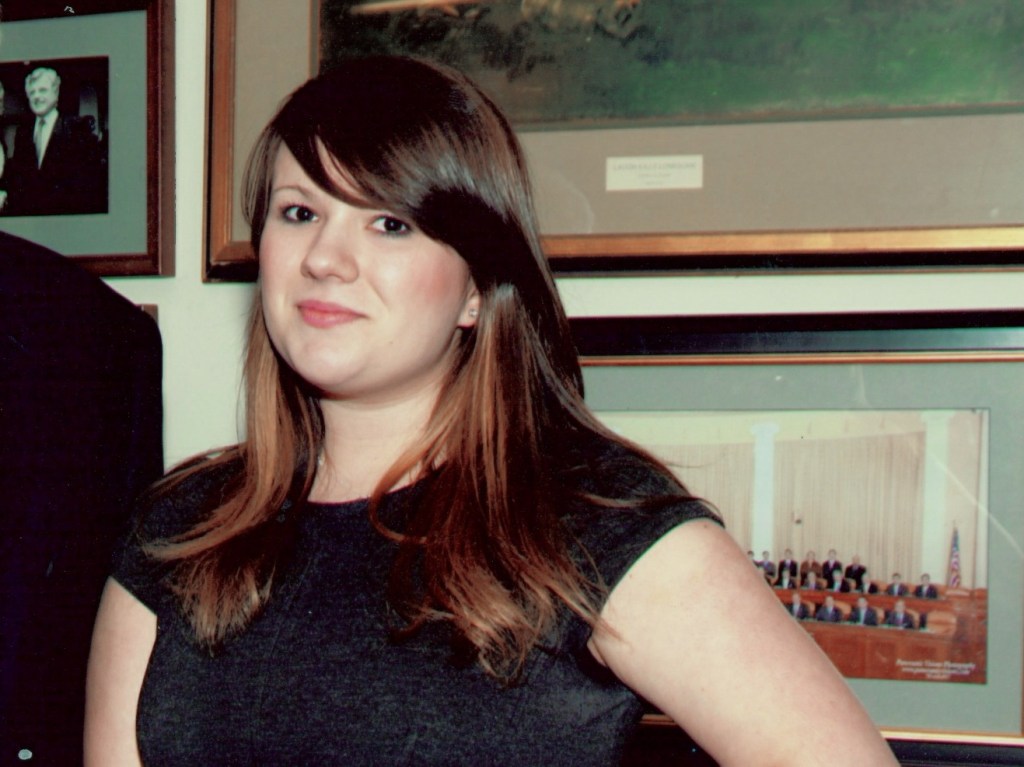
Justice Scalia, the infamous crank of the US Supreme Court, had appeared to be sleeping. But when his beady eyes snapped open and he made a snarky comment atan attorney’s expense, he inadvertently rescued me from explaining how an American Studies student from Flinders University of South Australia, had talked her way into the most superior court of the United States.
My highly-prized front row seat was the result of several lucky factors. The largest, by far, was my selection to the hyper-competitive Washington Internship Program. Unique amongst similar offerings in Australia, it is the crown jewel of Flinders, the smallest public university in one of Australia’s smallest capital cities. Since starting in 2000 the program has sent 75 students to work for the US Congress.
But back to the court. The cover story for my presence was far more elaborate. ”So, how did you get this seat?” the elderly mother of a Harvard-educated lawyer had asked curiously. She was sitting next to me but her eyes were trained on her son, one of the lawyers of the case, as he prepared for his opening argument. I hoped my gulp was inaudible. An untalented actress, my response was a shaky, uncertain, “um … I’m a visiting legal fellow from Australia?”

That was a mistake. The seat on my other side was occupied by another lawyer, a Yale graduate, whose eyes lit up with interest. “Fantastic! I did a few fellowships myself! Where is yours? What’s the topic? Who is sponsoring?” It was at that point that Justice Scalia saved me from further inquisition.
The “legal fellowship” was, in fact, a ploy by the Office of the US Congressman for whom I spent two months as an intern. After rigorously studying American politics for four years at Flinders (and another four years before that observing it), and thanks to the tireless work of the head of the American Studies Department and creator of the Washington Internship Program, Professor Don DeBats, I abandoned the sunshine and barbeques of the Australian summer and embraced a frosty winter of full time work in Washington, DC.
When the congressman’s chief of staff discovered my affinity with the court, she threw me a wink, picked up the phone, dialed the court’s number and asked for a reserved seat for their “lovely Australian visiting legal fellow”. The public wished they had access like this; on the other hand I had no idea what to do with it. At first.
The hero-worship was hard to shake. Sure, I had read many a books about Congress, most with contemptuous titles hinting at the body’s dysfunction (“Do Not Ask What Good We Do” or, even better, “It’s Even Worse Than It Looks” come to mind). But when I asked to go to an event featuring Nancy Pelosi, the highest ranking woman in American political history, I shook her hand and had only moderate success in suppressing my squeal. And when I volunteered to run some documents over to the Senate, I left my dignity in my cubicle because as soon as I passed the office of Saturday Night Live comedian-turned-serious-politician Senator Al Franken, I was furiously grabbing my camera and fanning myself.
I was lucky. My congressional office was remarkably laid back and accommodating, and when I stayed late a few days to finish off some typing, they thanked me profusely for being “the best intern ever” (privately, I wondered what kind of interns they had had before me). Nevertheless, every day presented a long list of rare opportunities, and all I had to do was ask. I was in the smoothest talking city in the world, and the influence was beginning to rub off onto me. I offered to escort some tourists to the White House, and when I greeted them enthusiastically in front of the iconic structure, they gave me a curious look. “So, how come an Australian is showing us around our own government?” they asked with playful grins. This time, I laughed with only a bit of self-consciousness.
Stay informed, daily
Eventually, it became second nature. On my last day, I walked to the grand Capitol complex, one of the most highly guarded buildings in the world, and sashayed inside easily with a quick flash of my staff badge and a glib “g’day” or “thanks, mate” to the dozen or so armed police outside, aware that they got a kick out of the stereotypical Aussie words that I hardly ever used back home.
My circular self-reflection had reached a moment of clarity. That a couple of months in the midst of American politics taught me more than the prior eight years I had spent entranced by it. Not just about the system itself, but about seizing opportunity. That talking my way into the Supreme Court or the White House was the easy part. Even in this foreign, prestigious setting, all I had to do was ask.
Want to see more stories from InDaily SA in your Google search results?
- Click here to set InDaily SA as a preferred source.
- Tick the box next to "InDaily SA". That's it.