Gillard paved the way – but who will follow?
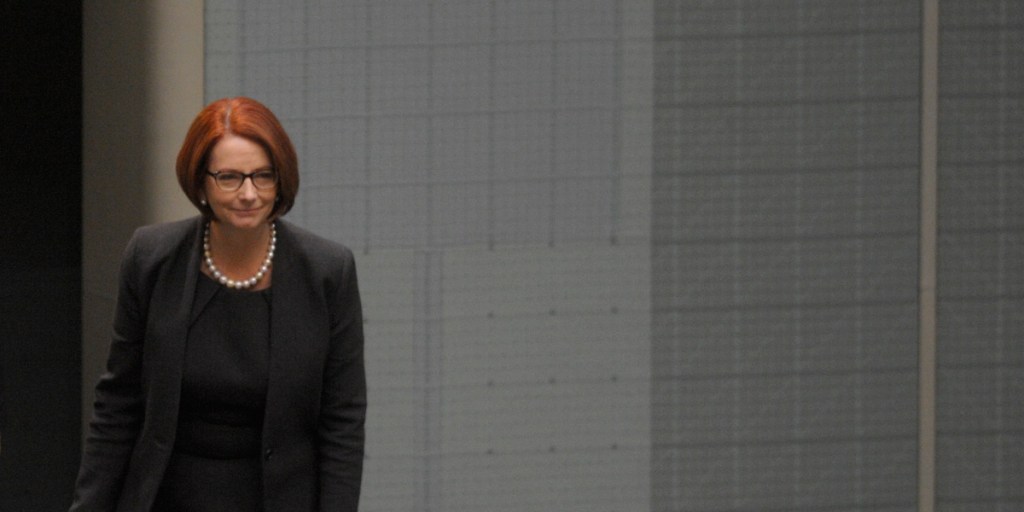
Zero per cent of young women who answered a YWCA survey after Julia Gillard was dumped as Prime Minister felt inspired to enter politics – now is the time to encourage them, says Chelsea Lewis.
Julia Gillard was right last Wednesday in her post-spill speech when she said that because she has been the first female Prime Minister, it will now be easier for women who come after her.
What we need now is to make sure we have women who want to come after her.
This week has seen an outpouring of emotion from young women members of the YWCA. Some in their early 20s are lamenting they won’t see gender equality achieved in their lifetime.
They are feeling a profound sense of loss and a deep sadness. It has much less to do with political parties and much more to do with how the former Prime Minister was treated, and the gendered nature of that treatment.
It is early days and I anticipate that many of these young women will follow the Kubler Ross stages of grief and when the acceptance stage arrives, so will some hope for the future.
"It is neck and neck between being ‘completely disillusioned by politics’ and being ‘more motivated than ever to work for change’. We can only hope that as the veil of sadness begins to lift, that more will tick the box for change."
You might like
It wasn’t all that long ago that people would point to our first female Governor-General, first female Prime Minister, and the swag of female Premiers and Chief Ministers from one end of the country to the other and say: ‘Look. See. You’ve made it.’
But they didn’t look back at the incredibly long and so often difficult road that was travelled to reach that historic period in time. And all too quickly we have seen a decline in those numbers. Today we have just three remaining: the Governor-General Quentin Bryce, one female Premier – Tasmania’s Lara Giddings, and one female Chief Minister – Katy Gallagher in the ACT.
Many of the speeches in the current Recognise campaign – raising awareness about updating Australia’s Constitution to recognise Aboriginal and Torres Strait Islander peoples – refer to symbols. And visibility.
It is much the same for women, who despite making up 51 per cent of the population, are also considered a minority group. They too need symbols and visibility.
But it’s not symbols for symbols’ sake. There is countless evidence that tells us when the gender balance is right, and when women are in decision-making roles, there are not only significant social benefits but serious economic rewards.
The way that Julia Gillard came to be Prime Minister has been held against her for the last three years, but despite this, the gravity of her achievement as being the first female in that role speaks volumes to girls and young women.
In YWCA’s annual SHE Speaks Survey for two years running Julia Gillard was selected as the most admired public woman for her achievement – chosen from a wide ranging list of women and their remarkable firsts.
This demonstrates just what it means to the next generations to see a woman in the ‘highest office in the land’. She was visible. She was a symbol. She inspired.
Stay informed, daily
A week ago, some of the same young women who have participated in these surveys were speechless. They were feeling silenced.
A poll on our website indicates there is a risk they will remain that way.
The poll asks for their reaction to the treatment of Julia Gillard. On the question of whether they feel inspired to enter politics: the answer is a resounding 0%.
It is neck and neck between being ‘completely disillusioned by politics’ and being ‘more motivated than ever to work for change’. We can only hope that as the veil of sadness begins to lift, that more will tick the box for change.
As a young women’s leadership organisation we expect the majority of people who access our website are young women. We know that among our membership many of the young women we attract are active and engaged in all areas of their communities. They are already leaders and they are the kind of leaders this country needs.
To see that not one of them is feeling inspired to enter politics begs the question about whether the treatment of Julia Gillard was sending an explicit message to the next generations to back off.
Our job is to encourage them to front up.
At the YWCA of Adelaide we run a young women’s leadership conference which young women routinely describe as the most inspiring and influential day of their lives.
We run a leadership program investing in young women at the start of their careers.
We are delivering GEM – Gender Equality Matters – an organisational cultural consultancy for businesses with more than 100 employees, enabling them to respond to the new Workplace Gender Equality legislation.
In primary schools we work with girls and boys on respectful relationships and positive body image and human rights, using an early intervention approach to shape the future attitudes of girls and boys knowing it will support the outcomes of women’s leadership.
It may well be that the next female Prime Minister will be among those students, or among our members.
For we will have another female Prime Minister. And it will be a little easier for her, because there was a first.
Chelsea Lewis is Communications Manager at the YWCA of Adelaide
Want to see more stories from InDaily SA in your Google search results?
- Click here to set InDaily SA as a preferred source.
- Tick the box next to "InDaily SA". That's it.