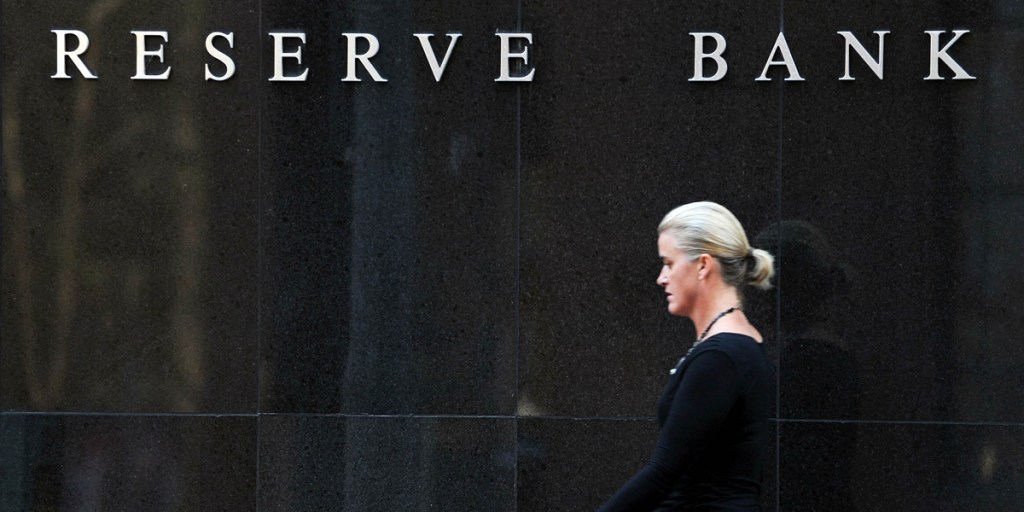
The central bank has kept the cash rate unchanged at a record low of 2.75 per cent at its July board meeting, with the outlook for the global economy looking a bit better.
In a statement accompanying the decision, Reserve Bank governor Glenn Stevens said global financial conditions “remain very accommodative”.
He also said the four rate cuts in 2012 have helped the economy.
“The easing in monetary policy over the past 18 months has supported interest-sensitive spending and asset values and further effects can be expected over time,” Mr Stevens said.
“The pace of borrowing has remained relatively subdued, though recently there are signs of increased demand for finance by households.”
Stevens added that Australia’s economic growth was still below trend.
“This is expected to continue in the near term as the economy adjusts to lower levels of mining investment,” he said.
You might like


The RBA governor noted that the Australian dollar had fallen more than 10 US cents since early April, but said the currency was still at relatively high levels.
“It is possible that the exchange rate will depreciate further over time, which would help to foster a rebalancing of growth in the economy.”
The RBA decision prompted a quick and furious response from a major trade union.
The Construction Forestry Mining and Energy Union said the board of the RBA has “failed in its legislated obligation to support jobs”.
“With inflation under control, economic data showing sustained weakness in sectors like manufacturing and construction, and growing numbers of job cuts being announced — including in the mining sector — the union believes there was an extremely strong case for a cut to rates.
CFMEU National Secretary Michael O’Connor said that while the RBA board continues to sit back and wait, economic conditions are deteriorating and the impact is falling squarely on jobs.
“Despite a raft of economic data that shows inflation is under control and many sectors of the Australian economy are weakening, the central bank has again chosen a ‘wait and see’ approach rather than acting decisively to aid growth.
“Despite the easing of the Australian dollar we are continuing to see a contracting manufacturing industry, while other sectors that would directly benefit from a rate cut — such as construction — are continuing to struggle and have been shedding jobs,” O’Connor said.
Stay informed, daily
“The Reserve Bank Act explicitly states that the RBA must ‘best contribute to… the maintenance of full employment in Australia.
“Today’s failure to cut rates, despite an upward trend in unemployment and weakness in many parts of the Australian economy, is a clear breach of this legislative requirement.
“The RBA needs to end their indecision, look at the realities in the Australian economy, take into account the challenging conditions in Europe and China, and cut rates.”
The Australian dollar fell below 92 US cents after the central bank’s decision.
At 1438 AEST, the currency was worth 91.84 US cents, down from 92.22 US cents shortly before the bank’s decision was announced.
The currency ended Monday’s local session at 91.99 US cents.
St George Bank chief economist Hans Kunnen said the RBA board was waiting to see whether the Australian dollar will fall further and what impact it would have on consumer prices.
“They’re clearly thinking hard about the impact of currency both on demand and on inflation,” Kunnen said.
“They want to see how that unfolds before making their next move.
“They’ve told us there is scope for another move should that be required.”
Kunnen said there would likely be another rate cut, to 2.5 per cent, in August following the release of inflation figures later this month.
Local lobby group Business SA said that while today’s decision was expected, business is still under pressure.
“We know that throughout the South Australia there is increasing strain on businesses being fuelled by rising costs, low consumer sentiment and other factors including the high Australian dollar, which is still relatively high,” Business SA’s director of policy Rick Cairney said.
“The challenges are not isolated to one area of the economy, with important industries including retail, manufacturing and construction all under significant pressure.”
Want to see more stories from InDaily SA in your Google search results?
- Click here to set InDaily SA as a preferred source.
- Tick the box next to "InDaily SA". That's it.