Every tree tells a story
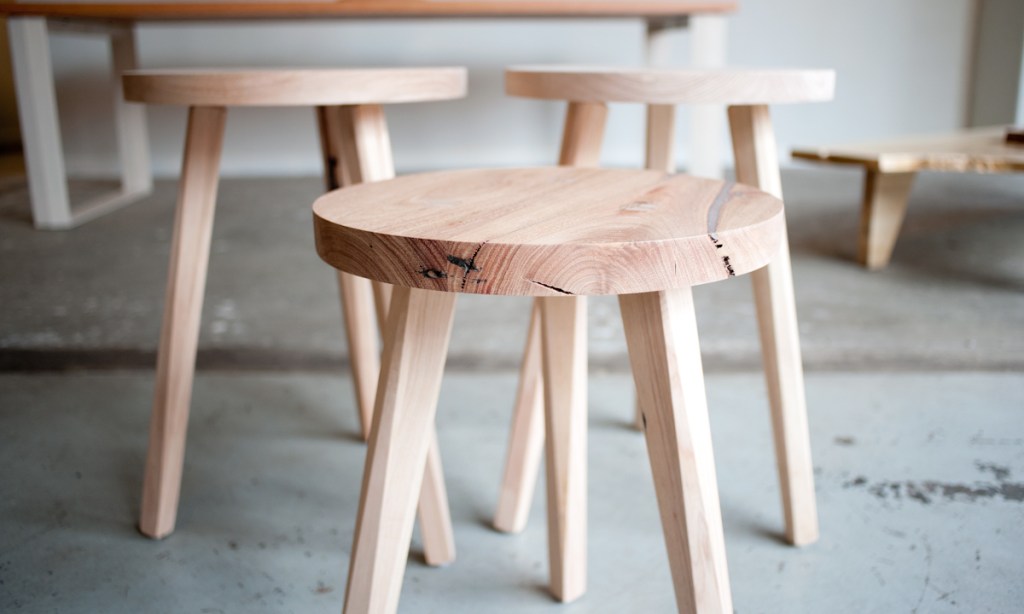
If you take an axe and cut down a tree, you’re left with a stump – and atop it, a pale tablet on which is printed a fine-grained record of its life. A story.
Just as each circle represents a year, each knot and whorl represents a struggle to reach the sun, or a battle with undergrowth fought and won.
That story is key in local woodworker Justin Hermes’ pieces.
“I try and do as little as possible,” Hermes tells InDaily Design as we sit in his airy and sparsely-furnished Logan Street studio.
“I try and leave the wood to do the talking. All of my designs are quite minimal. I don’t like to overwork things, and I don’t like to add unnecessary ornament.
You might like


“There’s generally enough excitement in the timbers that I use. So I just let the timber do the talking.”
Hermes, designer/maker / namesake at Justin Hermes Design, works with wood he scavenges from demolished houses, or rotten trunks felled in people’s backyards.
His pieces are extremely simple. Tables are little more than a rectangular slab of timber sitting on spindly legs. Above us in his workshop, bare bulbs dangle from a wooden cross in a crude candelabra.
The cuts that make the pieces are straight up and down with sanded edges. All colour comes from the wood itself. Each piece is made distinct not by anything Hermes has done but rather by the wood itself – by its story.
Stay informed, daily
“Each piece is unique, each piece is different, and I judge each piece of wood on its merits,” he says.
Most of the timber in Adelaide’s building stock is douglas fir, along with some spruce, imported from Oregon since the 1900s.
“It’s already done its carbon miles; it’s been used and it’s payed its dues,” Hermes says. “I’m happy to use it for my core designs.”
Among the other South Australian timber being salvaged is lemon-scented gum, which he describes as “beautiful, beautiful timber; really highly figured, and pretty dense and heavy”.
He’s also managed to score some stringybark, with three logs currently waiting for milling.
“Stringybark is good. That’s a paler timber, but not the most durable; it’s pretty volatile. You find it in some framing and under floors from early last century.”
While red gum is plentiful, Hermes is happy to leave that to other craftsmen.
“It’s that really, really deep red tone, through the pinks, which don’t really fit into what I want to do. It quite difficult, cranky timber to work with – [it] dulls blades, splinters easily, chips out. I let other guys deal with the red gum; they can have it.”
Want to see more stories from InDaily SA in your Google search results?
- Click here to set InDaily SA as a preferred source.
- Tick the box next to "InDaily SA". That's it.